The deep sea is home to lifeforms beyond our wildest imagination—creatures so alien they seem ripped from the pages of science fiction. Covering over 70% of Earth’s surface, the ocean remains largely unexplored, with more than 95% of its depths untouched by human eyes. Within this dark abyss dwell organisms shrouded in mystery, many of which science has yet to fully understand.
Some glow eerily in the blackness, others brandish needle-like fangs to snare their prey, and a few stretch to staggering lengths of over 100 feet—behemoths of the deep that defy belief.
In this feature, we’ve handpicked 15 of the most jaw-dropping deep-sea creatures from around the world, ranked for their sheer visual impact—whether it’s deadly venom, bioluminescence, colossal size, or otherworldly shapes.
Prepare to dive into the unknown and witness a fraction of the awe-inspiring mysteries lurking in the ocean’s darkest realms—secrets that humanity has only just begun to uncover.
About the Author
Former Journalist
Lily Parker
Hi, I’m Lily Parker from the Planet Life editorial team. As a former journalist, I’ve honed my research skills, and I’m passionate about exploring global cultures. I write about unique traditions and fascinating customs from around the world. My goal is to spark your curiosity and show you a different side of the planet.
No.15: Megamouth Shark (Megachasma pelagios)

In 1976, a new species of giant shark was accidentally discovered when it got tangled in the anchor of a U.S. Navy ship off the coast of Hawaii. This was the megamouth shark. True to its name, this shark is characterized by its massive body, which can reach 5 to 6 meters in length, and its enormous mouth. Despite its formidable appearance, its diet is surprisingly gentle. Breaking away from the image of a ferocious shark, it is a rare filter-feeder that swims with its mouth wide open to strain plankton.
Nearly 50 years after its discovery, only about 100 individuals have been sighted worldwide, earning it the title of the “phantom shark.” Its ecology is still shrouded in mystery, but researchers believe it uses a unique evolutionary adaptation to efficiently hunt in the deep sea: it lights up the inside of its mouth to attract and swallow tiny plankton.

The discovery of this species was a major shock to marine biologists at the time, as it challenged the conventional understanding of sharks. While its immense body and gaping, cave-like mouth are imposing, its nature is incredibly docile. As a mysterious deep-sea dweller, it continues to be a source of endless fascination for researchers. The discovery of the megamouth shark served as a powerful reminder that there are still large, unknown creatures lurking in the deep ocean.
No.14: Viperfish (Chauliodus sloani)

A deep-sea fish with “fangs of madness,” the fangtooth fish has long, gleaming fangs that protrude so far from its lower jaw they extend past its eyes. Its terrifying mouth acts as a “living cage” to ensure prey can’t escape. In some species, the fangs are so long that they would pierce the fish’s own brain if its mouth were to close completely, giving it the appearance of an ancient Dracula.
Despite being only about 30 cm long, this fish has light-producing organs on its belly that provide a camouflage effect, allowing it to blend into the faint light from above. It has a typical deep-sea fish behavior called “diel vertical migration,” where it hides in the darkness of 1000 meters during the day and rises to shallower waters at night to feed. This fish is found widely from the North Pacific to the tropical Atlantic, and its dark deep-sea ecology involves swallowing small fish and shrimp whole. Its glowing fangs make it truly a monster lurking in the abyss.

The fish’s bizarre morphology is an ultimate product of evolution, designed for efficiently capturing prey in the harsh, lightless environment of the deep sea. The bioluminescent organs are not only thought to attract prey but also to help the fish hide from predators looking up from below. Its unique ecology and eerie appearance make it a true symbol of the deep-sea’s mysterious world.
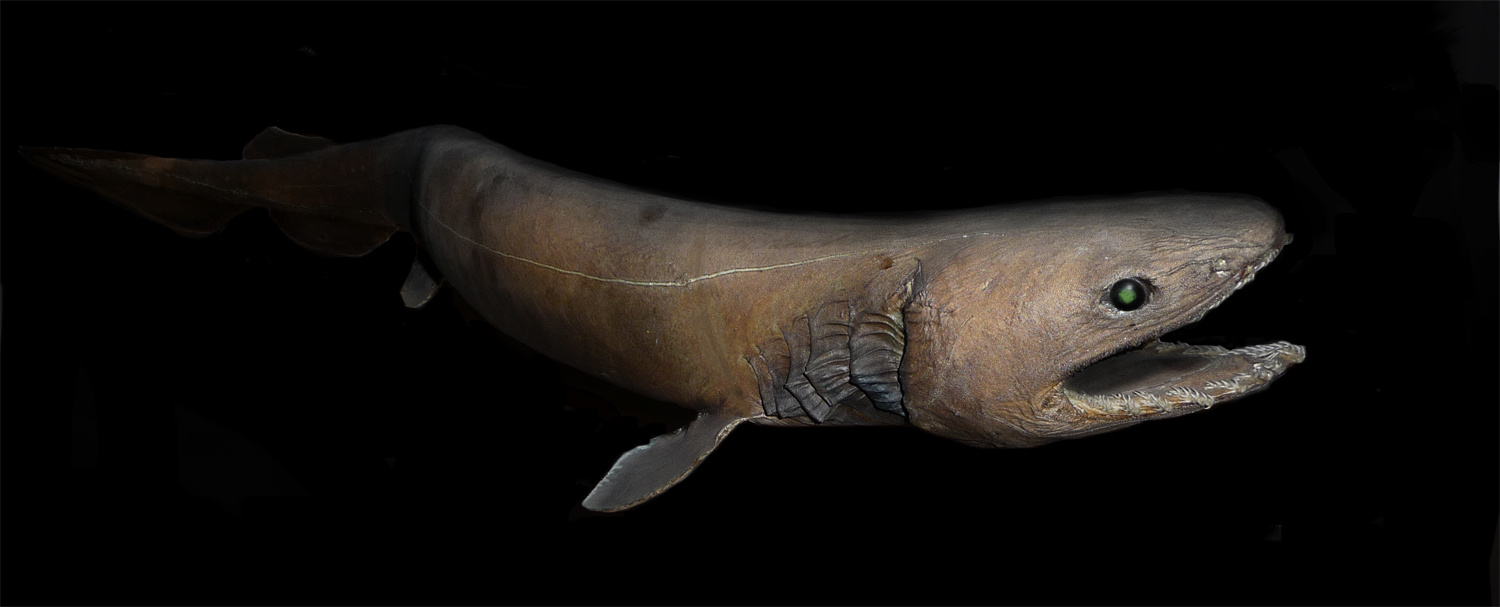
No.13: Frilled Shark (Chlamydoselachus anguineus)

Appropriately named a “living fossil,” the frilled shark is a mysterious animal whose primitive, eel-like body is said to be unchanged since the Jurassic period, resembling a mythical sea dragon. Its name comes from its distinct frilly gills, and its mouth is a veritable death trap, lined with 300 three-pronged, harpoon-like teeth arranged in 25 rows that form a “living cage” from which prey can never escape.
When it spots prey in the deep sea, it pounces with the agility of a snake. Once it bites, its slender, spiky teeth relentlessly entangle its struggling victim. Although it can grow up to two meters long, it’s extremely rare for one to be seen by humans. In 2007, a living individual appeared in the shallow waters of Suruga Bay, Japan, and its unusual appearance made major headlines, surprising researchers across the country.
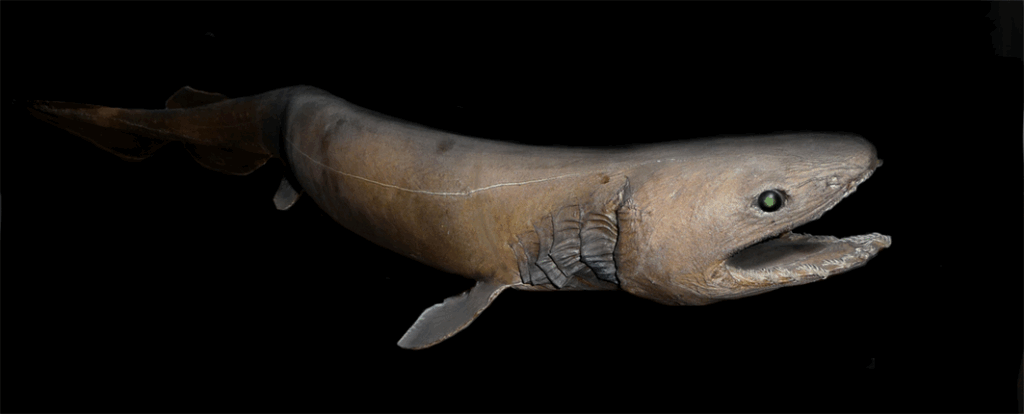
Known to lurk widely in the deep seas of the Atlantic, off the coast of South Africa, and in other parts of the world, its very existence tells a story of the mysteries hidden in the depths of our planet. The frilled shark’s primitive features are incredibly significant for paleontological research. Its appearance, as if it has time-traveled from the past, may just offer us a glimpse into a time on Earth that we have yet to discover.
No.12: Pelican Eel (Eurypharynx pelecanoides)

There are bizarre creatures in the deep sea that look like they’re straight out of a cartoon. One such creature is the pelican eel. It has a tiny head, but a disproportionately massive, sack-like mouth that opens wide in a spectacular fashion when it finds prey. The eel looks more like a long tadpole than a traditional eel, normally appearing as thin as a string. But the moment it attacks, its jaws inflate like a balloon. It gulps down prey along with a large amount of seawater, then expels the water through its gills, leaving the trapped prey to be swallowed whole in one gulp.
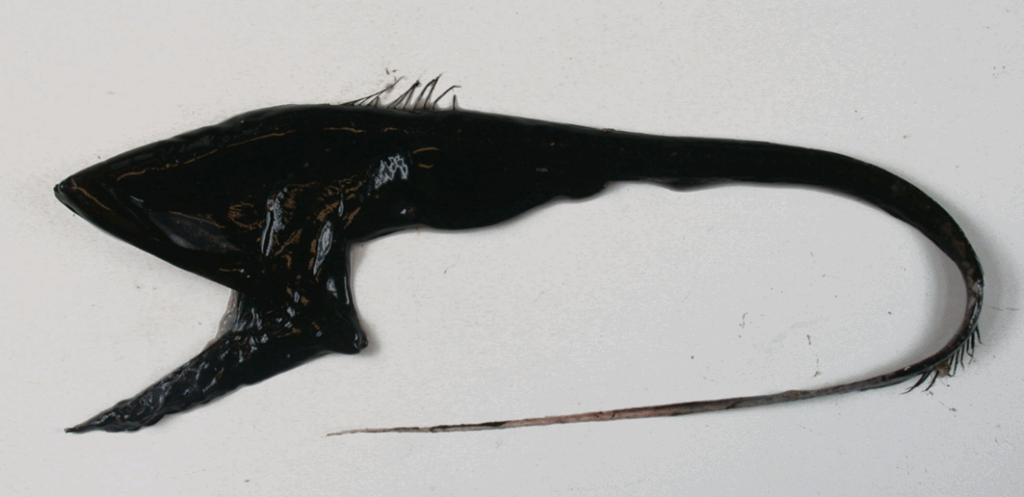
The pelican eel grows to about one meter in length, but its mouth can open wider than its own body, allowing it to swallow prey even larger than itself. It also has a pink, glowing lure at the tip of its tail to attract prey. This legendary deep-sea fish, with its monstrous eating habits and appearance, has earned nicknames like “deep-sea pelican” and “black sack.” It lives widespread in the Atlantic and Pacific oceans at depths of 500 to 3,000 meters.
Its bizarre way of eating is the ultimate survival strategy for a food-scarce deep-sea environment. It is believed to have evolved this unique form to ensure it can efficiently hunt and consume any prey it encounters.
No.11: Dumbo Octopus (Grimpoteuthis spp)
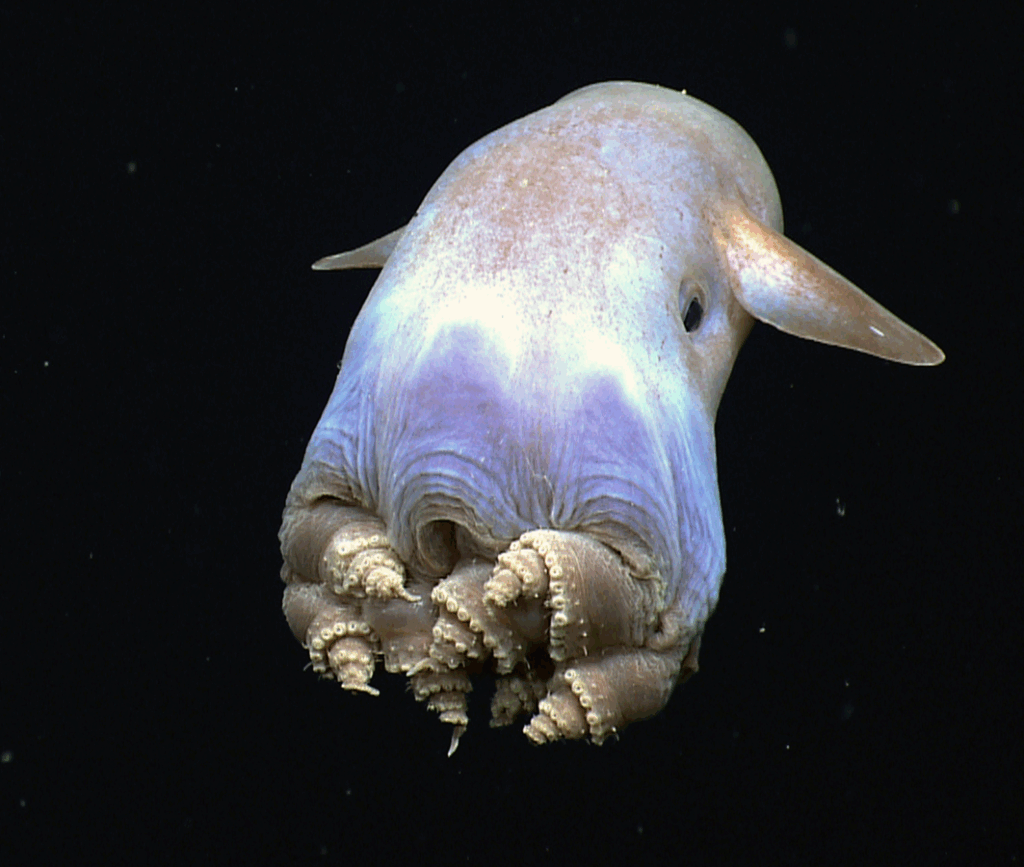
With its rounded body and wing-like fins, the Dumbo Octopus looks like a character straight out of a children’s movie—hence its name, inspired by Disney’s Dumbo. These delicate cephalopods drift gracefully through the water, flapping their ear-like fins as if performing an underwater ballet.
But don’t let its cuteness fool you—its home lies in the crushing depths of the ocean, at depths approaching 7,000 meters (23,000 feet). In fact, in 2020, one was recorded at a staggering 6,957 meters in the Java Trench, setting the depth record for any octopus species.
Typically about 8 inches (20 cm) long, Dumbo Octopuses feed on crustaceans and worms, skillfully navigating the seafloor for prey. Known as the “fairies of the deep,” they remain one of the most enchanting enigmas of the abyss, captivating researchers and explorers alike.
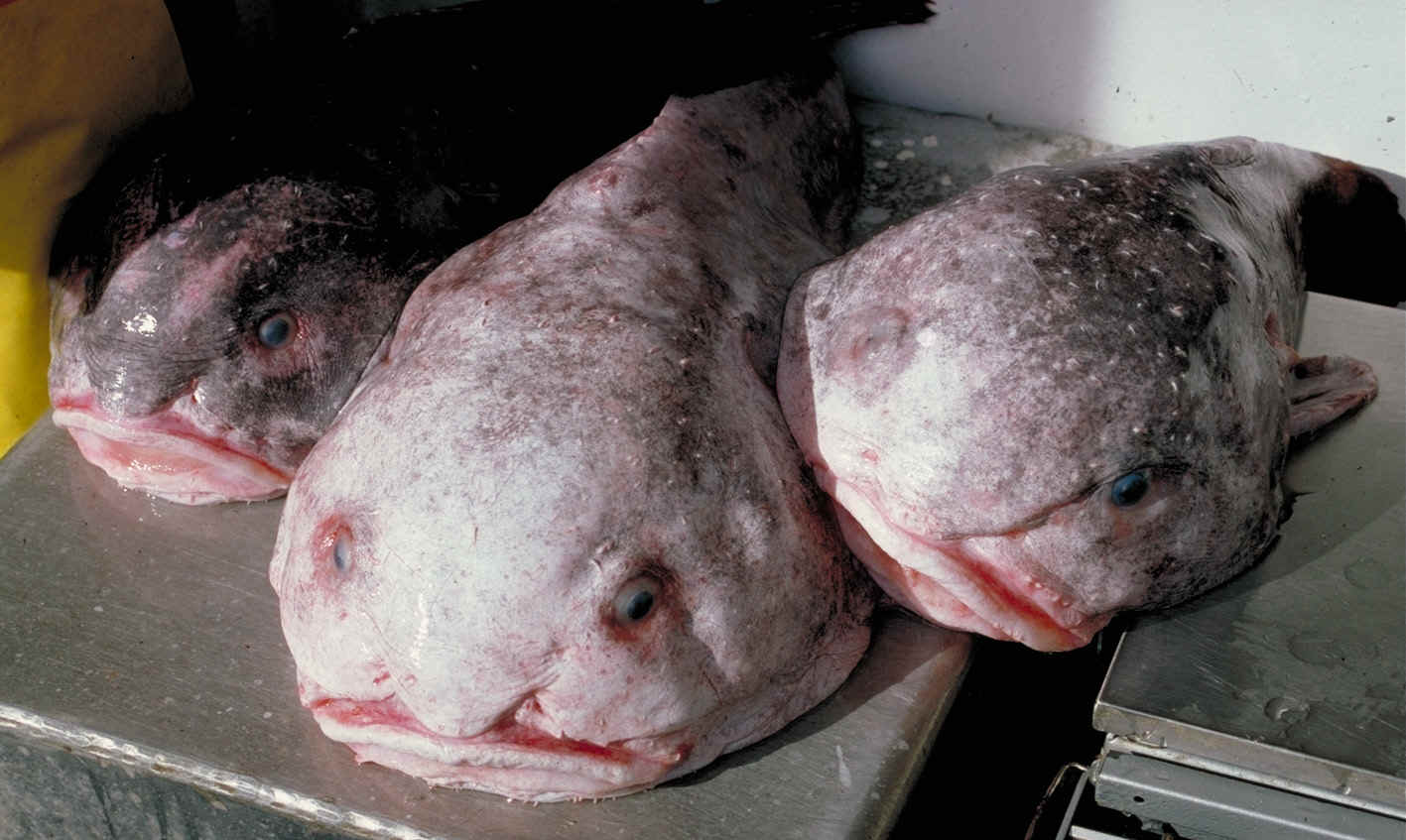
No.10: Blobfish (Psychrolutes marcidus)
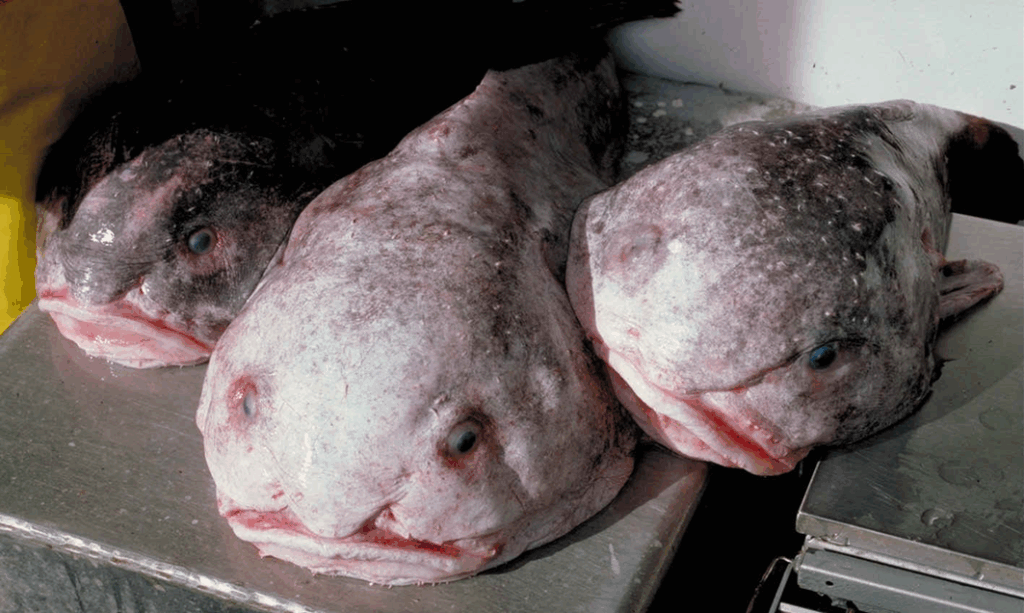
Imagine a saggy, pink gelatinous mass—that’s the Blobfish, crowned “The World’s Ugliest Animal” in 2013. Native to the deep waters off southeastern Australia and Tasmania (600–1,200 meters down), this strange-looking creature belongs to the sculpin family. Its Japanese name, Nyūdō Kajika, likens it to a bald-headed monk.
The Blobfish’s infamous look isn’t what it appears in nature. In its natural high-pressure habitat, it’s a fairly ordinary-looking brown fish. But once hauled to the surface, where the pressure drops dramatically, its gelatinous body collapses into the iconic blob-like shape that inspired its English name.
Despite its meme-worthy reputation, the Blobfish has a softer side: females guard their eggs with surprising devotion. Equal parts grotesque and oddly charming, this deep-sea oddball has become an unlikely pop culture star—and a symbol of the ocean’s strangest wonders.
No.9: Giant Tube Worm (Riftia pachyptila)

Discovered in 1977 by the submersible Alvin near the Galápagos Rift, these towering, white tubes crowned with vivid red plumes stunned the scientific community. Meet the Giant Tube Worm—a species that thrives where life was once thought impossible: near boiling-hot, toxic hydrothermal vents.
Growing up to 8 feet (2–3 meters) long, these worms have no mouth, stomach, or eyes. Instead, they host symbiotic bacteria inside their bodies, which convert volcanic chemicals into energy—a process called chemosynthesis. Their scarlet plumes extract hydrogen sulfide from the vent water, feeding their internal “chemical factories.”
Clusters of these worms rise like alien forests in the black abyss, a surreal display of blood-red “flowers” blooming in the darkness. Adapted to crushing pressure and lethal toxins, the Giant Tube Worm stands as a symbol of life’s resilience and mystery.
No.8: Atolla Jellyfish (Atolla wyvillei)
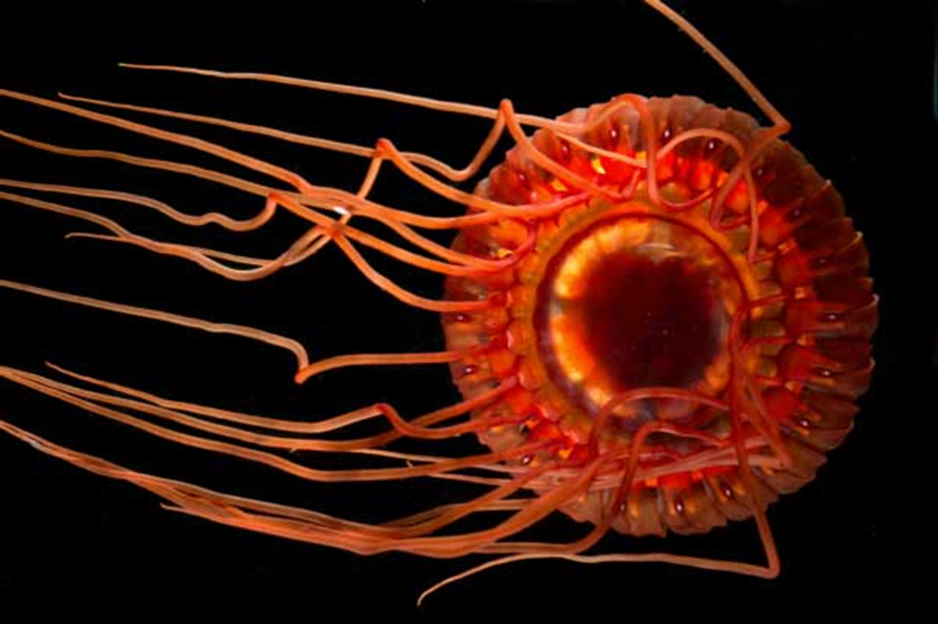
Picture a ruby-red jellyfish drifting serenely in the darkness—until danger strikes. Suddenly, it erupts in pulsing rings of blue bioluminescence, an underwater distress signal known as the “burglar alarm” effect. This brilliant display is meant to attract even bigger predators, distracting the attacker and giving the jellyfish a chance to escape.
The Atolla Jellyfish, typically found around 2,600 feet (800 meters) deep, has been observed by remotely operated vehicles glowing like a warning siren in the black void. Most of the time, it floats peacefully, snaring small fish and plankton with its trailing tentacles. But when threatened, it becomes a living flare—a beacon of survival in the eternal night.
No.7: Yeti Crab (Kiwa hirsuta)

Nicknamed the “Abominable Snowman of the Sea,” the Yeti Crab is a ghostly white, hairy-clawed crustacean discovered in 2005 near hydrothermal vents 7,200 feet (2,200 meters) down in the South Pacific. Nearly blind, with reduced eyes and long, silky setae (hair-like filaments) covering its arms, it looks like something out of a deep-sea fairytale.
But its lifestyle is even stranger: the Yeti Crab farms bacteria on its hairy claws, waving them over vent fluid so the microbes can feed on toxic chemicals. Later, it scrapes and eats the bacterial mats it has cultivated—a form of deep-sea “agriculture.” Sometimes, up to 700 crabs cluster in a single square meter, forming writhing carpets in the superheated gloom.
Equal parts bizarre and adorable, the Yeti Crab is a shining example of survival through innovation in Earth’s harshest environment.
No.6: Vampire Squid (Vampyroteuthis infernalis)

Its name literally means “vampire squid from hell,” and its appearance lives up to the hype—a jet-black body, webbed arms like a flowing cape, and eyes glowing crimson in the dark. But despite its fearsome look, the Vampire Squid is a peaceful scavenger, feeding on drifting organic matter known as “marine snow.”
Neither true squid nor octopus, it represents its own ancient order, Vampyromorphida. Though only about 12 inches (30 cm) long, it boasts some of the largest eyes in the animal kingdom relative to body size—a vital adaptation for the pitch-black deep.
When threatened, the Vampire Squid performs its signature move: the “inside-out cloak.” It folds its arms over its body, exposing spiny projections while tucking in vulnerable parts, a dramatic defense posture that inspired its name. Found in oxygen-depleted depths between 2,000 and 3,000 feet (600+ meters), this enigmatic cephalopod blends gothic horror with alien elegance—a true aristocrat of the abyss.
No.5: Green Bomber Worm (Swima bombiviridis)

In the black void of the deep sea, a creature barely 1.2 inches (3 cm) long has developed one of the most spectacular defense tricks in the ocean. The Green Bomber Worm, an annelid discovered off California’s Monterey Bay, releases glowing, grenade-like sacs from its body when threatened. These bioluminescent “bombs” drift away, flashing an eerie green light for several seconds—enough to confuse predators and let the worm slip into the darkness.
Found as deep as 11,800 feet (3,600 m), these worms often swim in groups, scattering bursts of emerald light like undersea fireworks. This strategy is a perfect example of extreme adaptation in a hostile environment: survival by outshining danger.
No.4: Praya dubia (Praya dubia)
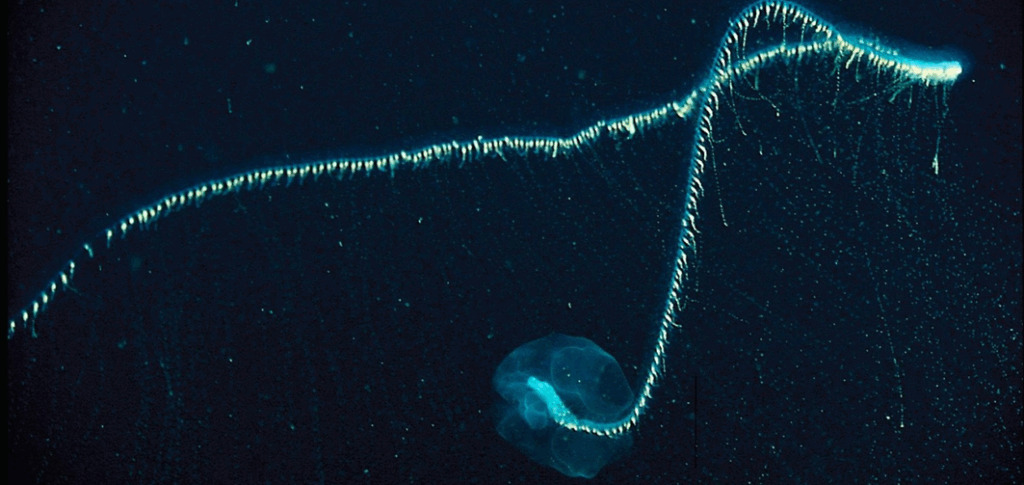
Imagine an otherworldly, glowing curtain drifting through the abyss. That’s Praya dubia, a siphonophore—an organism that isn’t a single creature but a colony of thousands of specialized units working together as one super-organism. Stretching over 330 feet (100+ m), it’s believed to be the longest animal ever recorded, far surpassing blue whales.
Its transparent, gelatinous body glimmers with blue-white light as it hangs in the water like an endless veil. Below, curtain-like feeding structures armed with stinging cells paralyze passing fish and crustaceans. Each segment, or zooid, serves a unique role—feeding, reproduction, locomotion—making this a “living assembly line.”
In 2020, researchers captured stunning footage of a specimen off Western Australia, its spiral form glowing in the inky blackness. Equal parts beauty and terror, Praya dubia represents the alien elegance of life at extreme depths.
No.3: Black Seadevil (Melanocetus johnsonii)

Jet-black, round-bodied, and armed with dagger-like teeth, this anglerfish dangles a glowing lure above its gaping maw to attract unsuspecting prey. Known as the Black Seadevil, this predator lurks at depths beyond 4,900 feet (1,500 m), where sunlight never penetrates.
But its most shocking feature? Sexual parasitism. While females grow up to 8 inches (20 cm), males are tiny—just a few centimeters long. Once a male finds a mate in the infinite dark, he bites her skin and fuses into her body, eventually becoming little more than a sperm-producing appendage. A single female may carry multiple fused partners on her abdomen—a bizarre yet effective strategy in a world where encounters are rare.
Filmed alive for the first time off California in 2014, this nightmarish anglerfish is both grotesque and fascinating—a true devil born of the deep.
No.2: Barreleye (Macropinna microstoma)

Meet the Barreleye, a fish so strange it seems like a creature from a sci-fi movie. Its head is a transparent dome, revealing two glowing green, tube-shaped eyes inside—eyes that rotate like gun turrets. Normally, they point upward, scanning the darkness for faint silhouettes of prey. When it strikes, those eyes swivel forward for pinpoint precision.
Discovered alive only in 2004, this 6-inch (15 cm) wonder stunned researchers in California’s Monterey Bay. Found at depths of around 2,100 feet (650 m), it’s a rare glimpse into deep-sea innovation. That crystal-clear head isn’t just weird—it helps refract light, enhancing the fish’s ability to survive in eternal twilight.
Restricted to the North Pacific, the Barreleye is one of the ocean’s most mind-bending marvels—a transparent window into evolution’s wildest experiments.
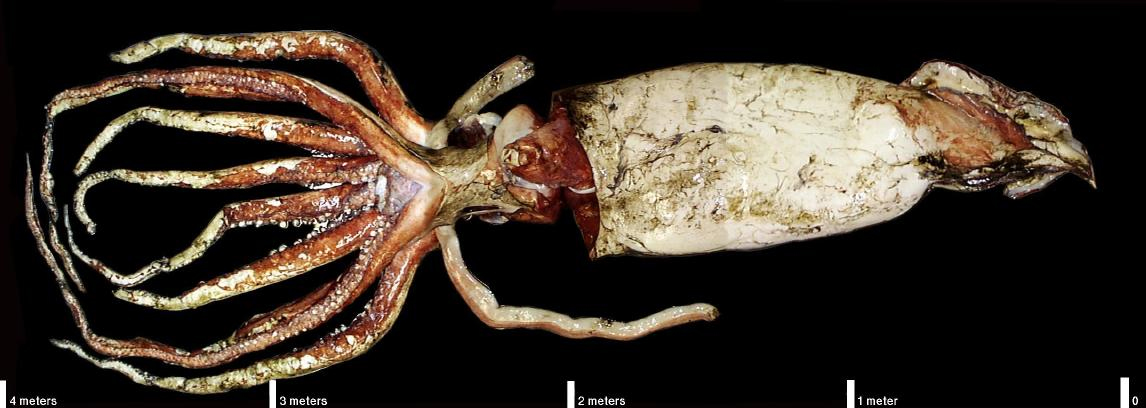
No.1: Giant Squid (Architeuthis dux)

Feared in sailor lore for centuries as the “Kraken,” the Giant Squid is the largest invertebrate on Earth. Reaching lengths of 59 feet (18 m) and weighing over a ton, it’s a predator built for the abyss. But its most astonishing feature? Eyes as big as a human head—nearly 12 inches (30 cm) across—perfect for detecting the faintest glow in the deep.
Armed with ten arms lined with suction cups tipped with serrated hooks, it can grapple with even sperm whales—the only known predators capable of taking it down. While dead specimens have washed ashore for centuries, footage of a live giant squid in its natural habitat was first captured by Japanese researchers in 2012, electrifying the scientific community.
From Norway to New Zealand, this elusive leviathan roams the world’s cold, black waters—a colossal symbol of the ocean’s enduring mysteries.
Did you enjoy the journey? The deep sea is home to countless mysterious creatures that defy everything we thought we knew about life. Hopefully, these beings, still shrouded in mystery, sparked your curiosity.
This site features many more wonders and incredible stories from around the world. Be sure to check them out!