About the Author
Former Journalist
Lily Parker
Hi, I’m Lily Parker from the Planet Life editorial team. As a former journalist, I’ve honed my research skills, and I’m passionate about exploring global cultures. I write about unique traditions and fascinating customs from around the world. My goal is to spark your curiosity and show you a different side of the planet.
Always a little late

On a morning in Los Angeles, photographer Noah Reyes was once again accumulating “just five more minutes” of delay. The distance was short, preparations quick, traffic lights a matter of luck. Convinced of this, he overlooked the “actual time” spent charging equipment, formatting SD cards, and searching for parking. Small errors snowballed, and by the time he arrived, his heartbeat and voice were ragged, his first words failing him. The director’s expression darkened slightly, and the set’s atmosphere grew tense. To break this cycle, Noah opened his notebook and wrote down each reason for his tardiness as a “specific action.” He decided to stop imagining five minutes and start using the “measured 13 minutes” from his stopwatch.
— Tips : Starting today, I’ll measure the entire process. I’ll note the actual time for each step: waking up → getting ready → packing → departure → parking → check-in, then add a 15-minute arrival buffer to the total.
Mapping tardiness
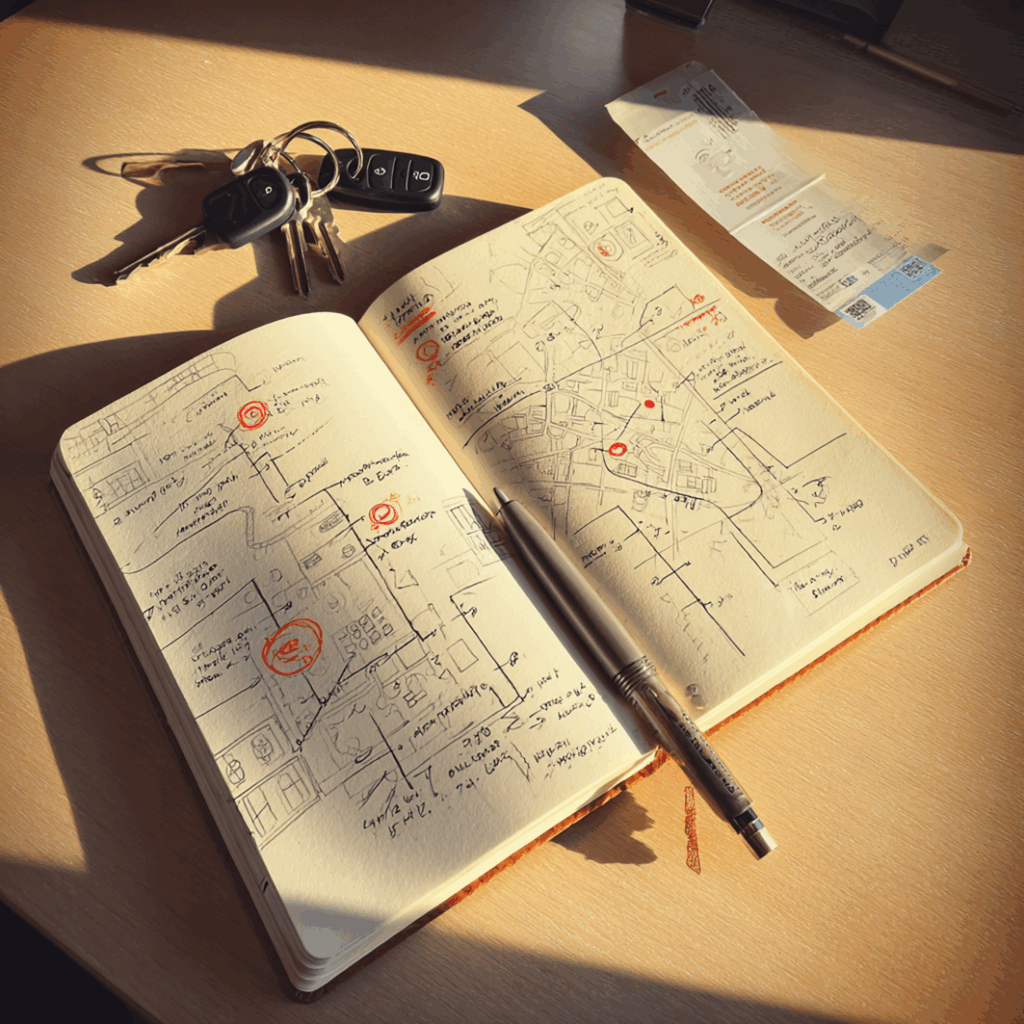
Noah mapped out his daily routine like a road map. Wake up → Shower → Pack → Front door → Parking → Elevator → Reception. He wrote the “actual time” for each segment and circled “probability events” like waiting at traffic lights, full parking lots, or getting lost at reception in red. Five minutes in his head turned into 13 minutes in reality, sometimes even 18. He also noted “easily overlooked detours” like lines at the payment machine or losing the parking ticket. No wonder I was late—I was running on roads not on the map. Once the map is complete, I can build detour routes.
— Tips : Paper or app—either works. Create your own “commute route map” using the basic formula: actual time × 1.3 (error buffer) + 15 minutes for arrival.
Reverse Calculation Block Start

Fill the calendar “backwards.” For a 9:00 meeting: arrival at 8:45, parking buffer at 8:30, departure at 7:30, packing at 7:00, wake-up at 6:30. Manage schedules by ‘blocks’ rather than exact times, and break tasks into “5-minute increments.” The night-before check is: “Battery 100% / SD card initialized / Lens cleaned / Secondary route option.” Alarms are set for: “10 minutes before departure / Leave home / Parking cutoff.” If one block gets delayed, immediately switch to the next best option at the “cutoff time.” With detours and emergency stops marked on the map, my morning breathing deepens.
— Tips : Create a reverse-planning template. Block out the sequence: “Gathering → Arrival → Parking → Departure → Packing → Waking Up.” Set a “cut-off time” for each block without fail.
First successful experience

Malibu Beach. Noah arrived 45 minutes early, letting the soothing sounds of tide and wind wash over him. With time to spare, his vision broadened. He spotted a loose screw on the tripod and immediately swapped it for a spare. He also checked the white balance beforehand. The director’s first words were, “That saved us.” The number of takes increased, and expressions softened. Noah jotted down three reasons for the success in his notebook: ① Arriving early allowed him to spot the mistake ② Bringing spare parts ③ His voice stayed calm. He understood physically that success wasn’t luck, but the result of careful planning.
— Tips : Establish a 3-minute check upon early arrival (15-45 minutes early): equipment tightness, spare gear confirmation, WB/exposure. Shift mindset from “Arrival = Ready” to “Arrival = Start with room.”
The Night Trust Returns

Downtown music bar. Noah tests lighting angles ahead of schedule and eliminates sound feedback early. Having time to spare means solving others’ problems too. After filming wraps, the staff relaxes, and talk of the next project flows naturally. Noah established a “reward rule”—on days they finish early, tacos on the way home, a warm shower, and pre-bed stretches. The next shoot needs something to look forward to. Small pleasures make the next day’s countdown feel lighter. Trust can’t be measured in numbers, but you can feel it in the air. Conversations increase, and new projects come back.
— Tips : Early completion = Link it to small rewards. Choose three “reward sets” that make you happy, unlock them only on days you finish early, and make it a habit.
A morning saved by having time to spare

Roof-top shoot at dawn. Noah arrived 30 minutes early, spotted a loose fence panel, and notified the manager. The moment an assistant leaned against it later, the fence nearly gave way. Arriving early isn’t just a luxury of time. It’s insurance against one less accident. The streak of zero tardiness stretched into double digits, and “I’ll be a bit late” vanished from introductions. On the back of his business cards, “On Time” was printed in small letters. His confidence settled into a quiet tone, easing the tension on set.
— Tips : The first five minutes after arrival are for a “safety sweep.” Check for falling objects, loose parts, and wiring once around the perimeter before opening the equipment.
Design Side Effects

When things go too smoothly, greed rears its head. Noah began sacrificing sleep to build a thicker buffer, disliking signals and accelerating through yellow lights, and fixating on the shortest route. “Not falling behind” became the goal, and the design for rest grew thin. His reactions slowed slightly, and his field of vision narrowed. So Noah added “red rest stops” to his map. ① The 7-hour sleep block is inviolable. ② Do not accelerate at yellow lights. ③ If feeling rushed, stop for 30 seconds and take three deep breaths. Arrival matters, but safety and recovery matter more.
— Tips : Prioritize establishing a consistent sleep schedule (same bedtime and wake-up time daily). Driving rules: “Don’t step on the gas when the light is yellow” and “If you’re in a hurry, stop for 30 seconds.”
Add rest design

The night before a major project, Noah posted three rules on the wall: “Enter after opening,” “Cancel one plan on sleepy days,” “Pause when panicking.” On the day, he arrived at the site at 6:50, but parking lot ventilation started at 7:00. He chose to wait in his car, using the five minutes to double-check preparations, drink water, and nibble on a nutrition bar. In the past, he would have chosen to “just go in.” The courage to wait is proof of composure. For the first time, Noah prioritized “arriving safely” over “making it on time.”
— Tips : Confirm the “opening time” in advance. If you arrive early, wait outside or in your car, and make it a routine to double-check your checklist and stay hydrated.
Map Extension

The design expands further. Add “Safety Checks (Ventilation/Lighting/Traffic Flow)”, “Withdrawal Lines (Danger Thresholds)”, and “Double-Checking (Mutual Verification with Partner)” to the checklist. Upon arrival, establish a fixed routine: “Take a deep breath → Greet venue staff → Walk around once to check for hazards”. Small close calls vanish before they happen, and filming proceeds smoothly. Requests increase, and smiles return to the team. Noah realized: Mastering time isn’t about rushing, but deciding where to pause.
— Tips : Make “Safety Check Every 3 Minutes” a standard procedure. Define and share withdrawal criteria (e.g., poor ventilation, unstable scaffolding) with the team in advance.
The Future Shaped by Maps

Six months later, Noah started a “Time Map” workshop for juniors. Maps of tardiness, countdown blocks, sleep blocks, post-opening entry, retreat lines. Participants’ tardiness rates visibly dropped, and on-site accidents decreased. He himself began and ended each day with ease, capturing more light. He could sleep even on deadline nights. Noah closed his planner and smiled quietly. “Not being late” wasn’t the goal—it was the gateway to gentle work. A map isn’t complete for just one person. The more it’s shared, the more the city becomes a little kinder to time.
— Tips : Swap your “Time Map” with one person and hold weekly review sessions. Set “Arrival + 15 minutes” as the default for everyone’s schedule to establish a team standard.